Showing posts with label Amp. Show all posts

Wednesday, September 8, 2010

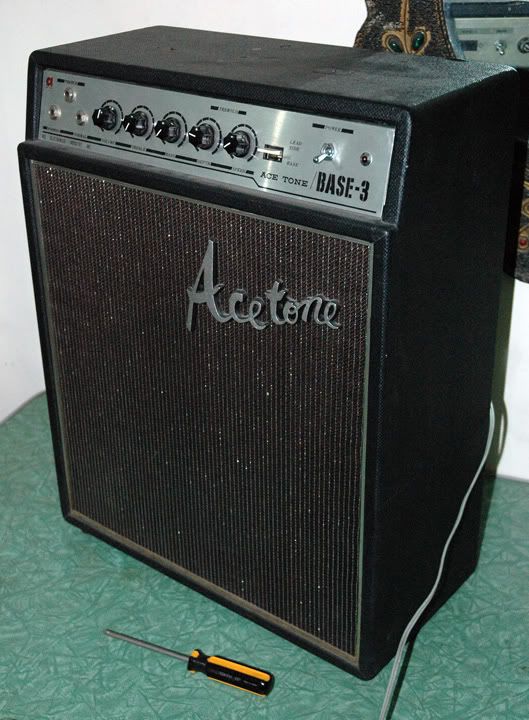
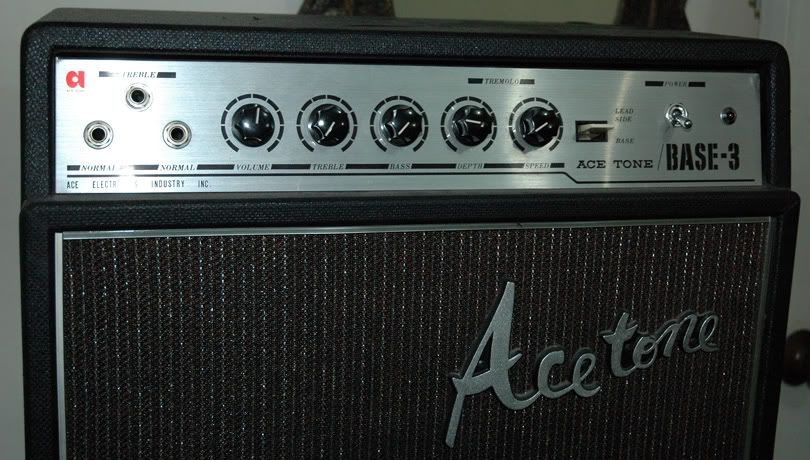
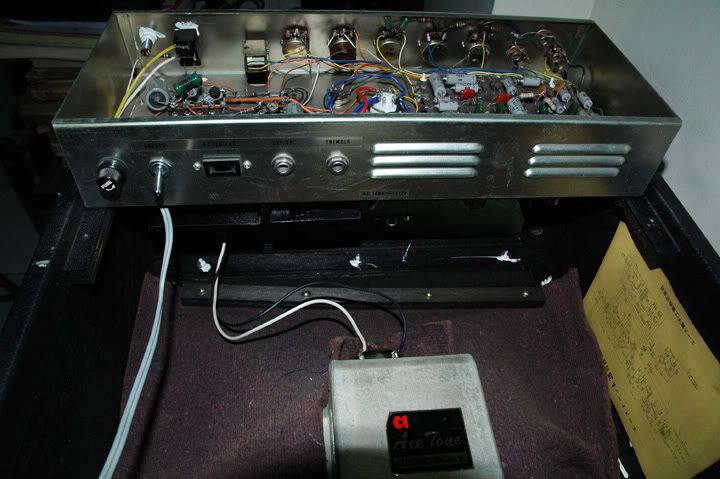
Ace Tone Base-3 Tube Amp / Ace Tone A-3B Tube Amp

Ace Tone Base-3 Tube Amp
aka Ace Tone A-3B Tube Amp
1960's?
Made in Japan, 100V

Tube Complement: 2 x 50H-B26 power tubes, 2 x 12ax7 preamp tubes, 1 x 6av6 tremolo tube

Speaker: 8-ohm, Alnico 12in., Ace Tone branded

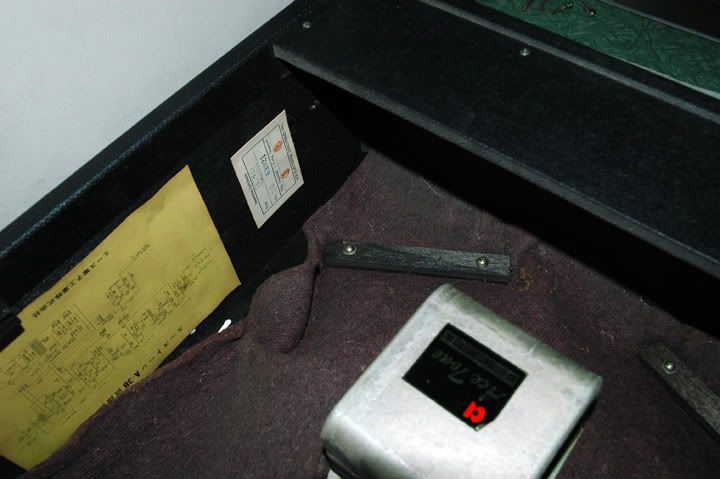
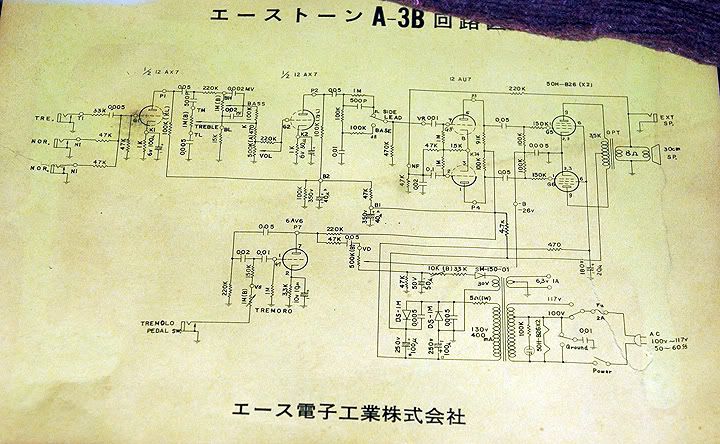
I've searched and searched and searched and could not find any information about this amp from the net. Fortunately, the amp came with a full schematic so all is not lost.

This is a highly intriguing amp. In original form, it uses an unheard-of power tube, namely, 50H-B26. Some info are available on the net for this tube so this is another plus.

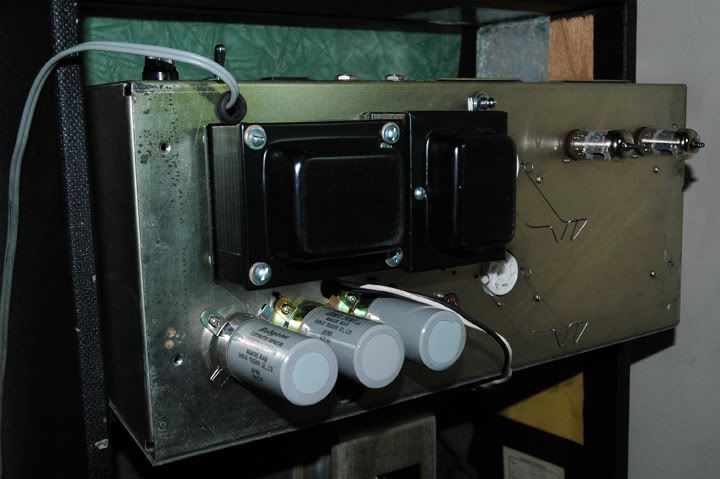
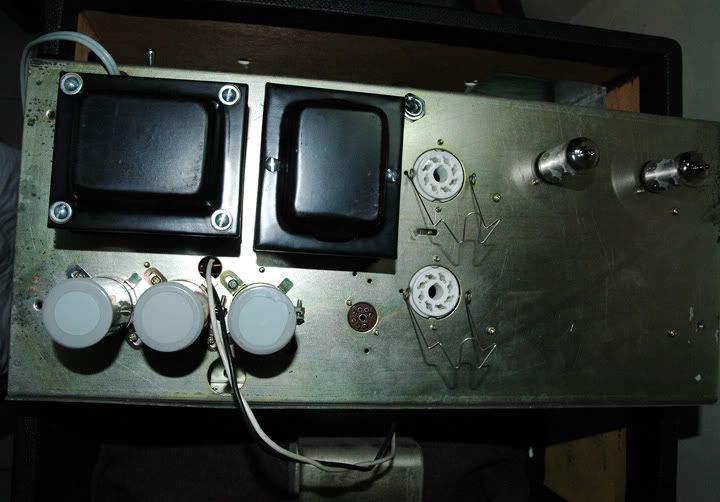
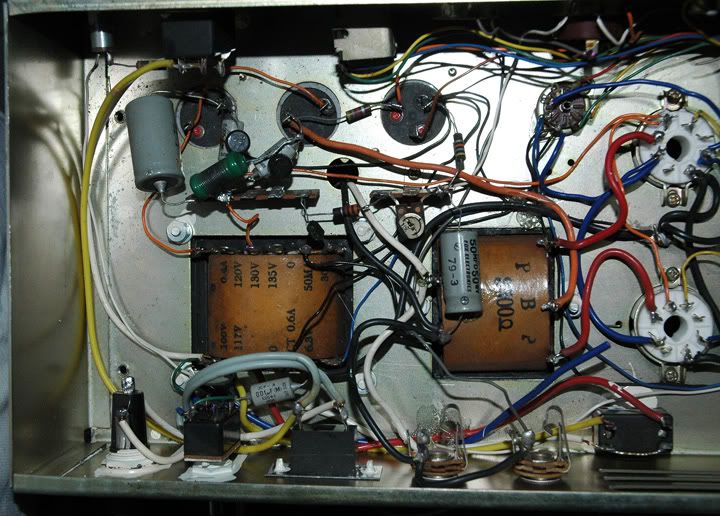
This tube requires 50V AC for filament power and the filament of the 2 power tubes are connected in series at the primary side of the power transformer, getting filament power directly from the 100V Japanese house voltage.

This explains why the 6.3 V output of the power transformer is designed for 1 Ampere only. It only need to provide filament power to two 12ax7s and one 6av6 tube. The power transformer therefore does not need to be so big.

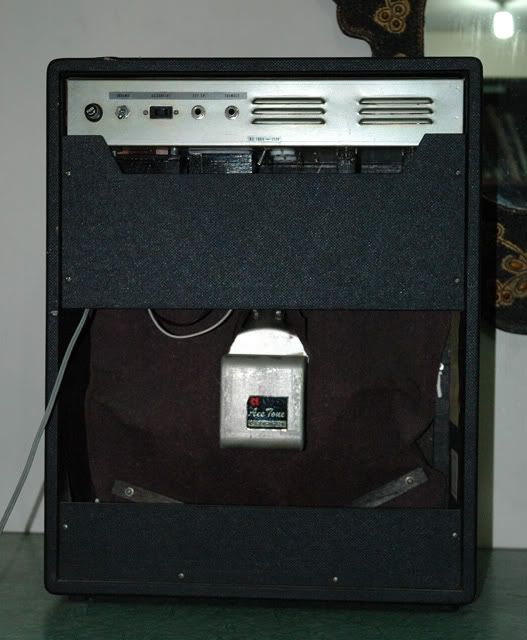
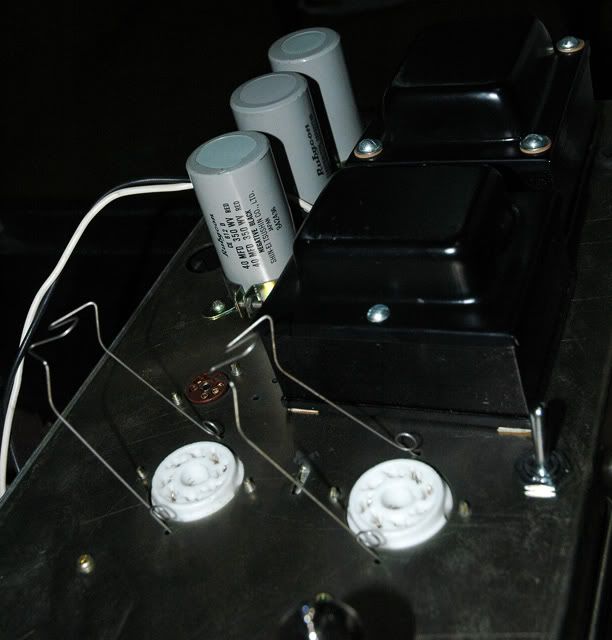
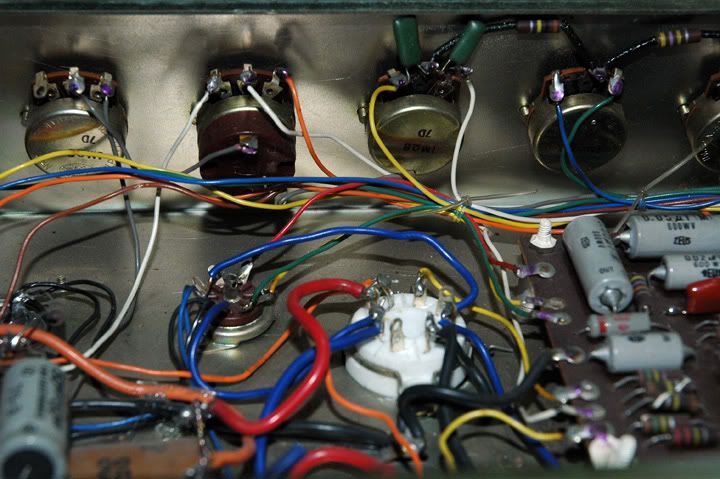
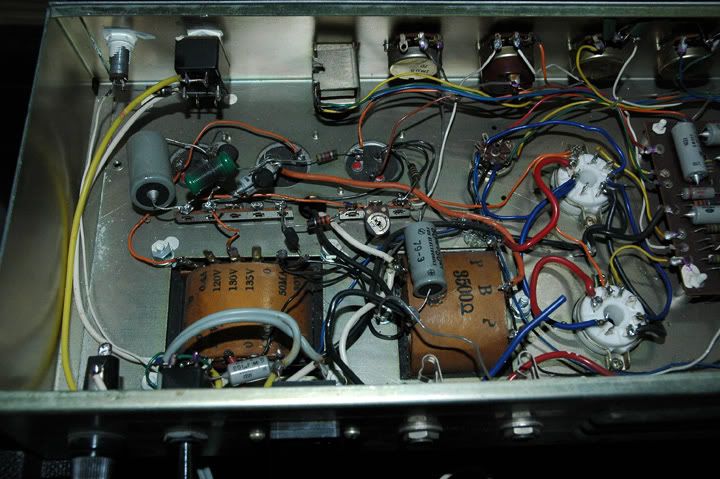
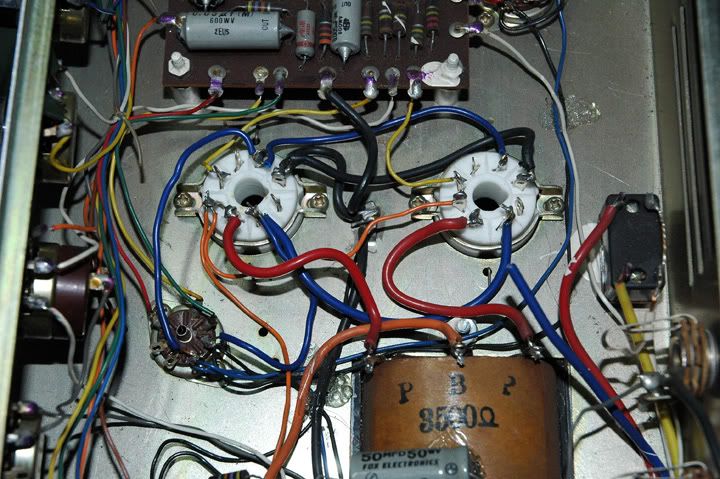
When I got it, the power tube bases were already converted to accept 6V6s. Whoever did the conversion did not scrimp on the tubes as they were DELCO brand 6V6s. The replacement tube bases used are ceramic type.

The work was done cleanly and looked like it was executed by somebody who knows what he was doing. Only upon consulting the schematic and looking closely on the actual amp components did I realize that the amp did not originally use 6V6s.

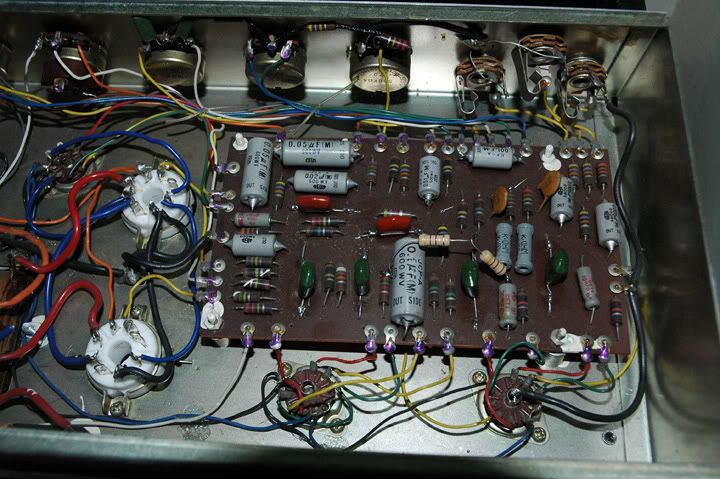
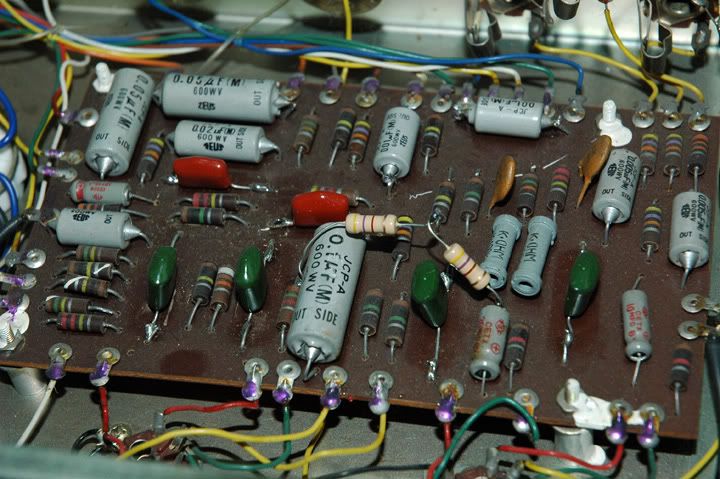
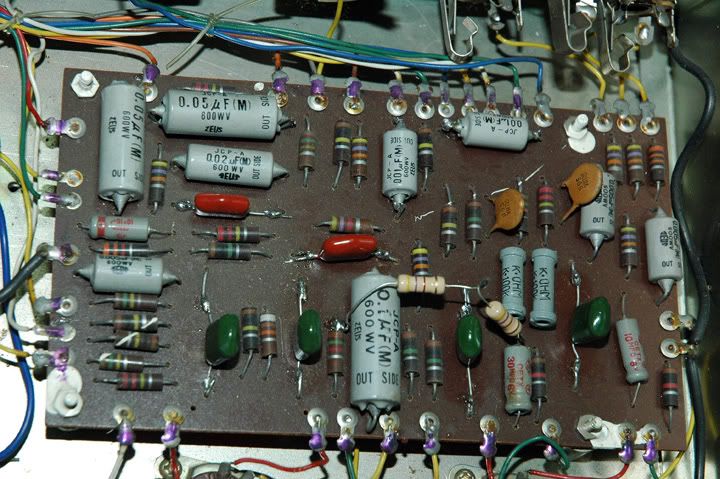
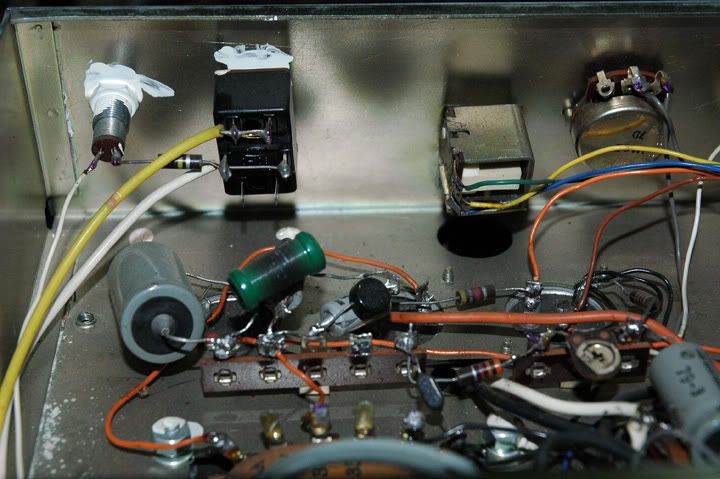
There is a minor modification done in the circuit board that does not look like it was done by the same person who did the tube conversion. It looked like temporary work to make a test. Fortunately this is easy to undo.

A number of the original paper-in-oil caps in the circuit board have been replaced.

The amp works and sounds good when I got it though there were no provisions made to supply the additional filament current required by the two 6V6s. It doesn't seem to have the power that could be expected from a push-pull 6V6 powered amp. This is most probably due to the lack of filament power to the preamp and power tubes.

I feel that the amp can give more output once a proper power transformer is installed or an additional filament transformer is added to supply the filament current required by the two 6V6s.

The 12-inch Alnico speaker has a big magnet and looks like it can handle 20 watts or more of output power. The speaker is blanketed at the back likely because the amp is designed for bass guitar as well as for guitar with a selector switch on the front panel.

The amp as it is, presents a very nice starting platform for conversion into any one of the classic amps as most of the ingredients are already there...


Thursday, March 26, 2009

Fender Blackface Showman 1966

Fender Blackface Showman Amp 1966
Serial No. A 07899

This is my second '66 Fender Blackface Showman. This also has a multi-voltage Transformer.

Wednesday, December 24, 2008

Teisco Model #62 Tube Amp

Teisco Model No. 62 Tube Amp
Made in Japan
Year circa '60s(?)


This is a one channel, Class-A (Single-Ended) all-tube guitar amp that puts out about 4W of power to one 6" speaker. There are four (7-pin) vacuum tubes specifically 2 x 6AV6 as preamp tubes, one 6AR5 power tube and one 6X4 rectifier tube.

This amp was marketed internationally under Teisco, Beltone, Northland, Takt and other brand names. There is a similar model with an additional 6AV6 tube and corresponding circuitry and controls for 'tremolo' effect. These 'tremolo' equipped models usually has 2 speakers.


It has 2 inputs, one volume and one tone control knobs, on-off switch and pilot lamp. I like the quality look and feel of the panel and its components.


The power transformer has a 110 and 220 Volt tap and a vintage knife-type SPST voltage selector switch.


There is very little information about teisco amps on the internet, I have not found any schematic so far.

I expect that the circuit would be very similar to vintage Gibson Kalamazoo Model One and Fender Champ 600 amps. The two 6AV6 preamp tubes in the Teisco would be equivalent to the two triodes (V1a and V1b) of the 12AX7 in the Kalamazoo Model One, shown below.


Schematic author is Miles O'neal of Austin, Texas and is originally from http://www.rru.com/~meo/Guitar/Amps/Kalamazoo/M1/schem.html

I added a phono plug and jack so that an external speaker can be conveniently plugged-in instead of the internal 6" speaker. I will fix the jack in a bracket to make it more secure and elegant looking.

Sunday, September 28, 2008

Fender Vibrolux Reverb

FENDER VIBROLUX REVERB
SERIAL NO. 25861
1973


The Vibrolux Reverb is a particularly interesting model among the Fender Amps equipped with reverb. It is an excellent sounding amp with enough power (35~40W) and comes in a manageable size and weight package. This makes it very attractive to gigging guitar players. Its 2 x 10 speakers is also a plus factor as these disperses sound better than a 1 x 12 speaker does. A nice article that discusses these are here: http://www.tonequest.com/articles/article2.htm


This particular amp has been restored with:

--- All new Sprague Atom Electrolytic caps: 5 x 20uF/500V filter caps, 7 x 25uF/25V cathode bypass caps and 2 x 100uF/100V bias supply caps.

--- New Sprague Orange Drop cap: 1 x .047 uF/600V (to replace one that looked like it was gnawed on by a rat)

--- New set of JJ/Tesla Tubes: 4 x 12AX7, 2 x 12AT7 and 2 x 6L6GC

--- New Fender (EH) Tube: 1 x 5U4 rectifier tube

--- New Hammond Ouput Transformer replacement for VR

--- New Light Dependent Resistor (LDA) Optocoupler for the Tremolo

--- New Accutronics Reverb Pan: 4AB3C1B

--- New Filter Capacitor Cover

--- New Pilot Light Bulb


Now this amp works 100% with lush reverb and strong tremolo with no extraneous sounds. The amp is so quiet, I can not tell it is on if I do not look at the pilot light.

The sound from this amp connected to the 2 x 10" ceramic (50W capacity each) Eminence speakers in my Seymour Duncan 84-50 is beautiful and inspiring. The amp has more than enough power to shake your pants, the floor and ceiling - it makes your hair stand. You not only hear sounds, you feel sound waves through your body.

This amps original cabinet is beyond repair so that would be the one remaining issue to complete the amps restoration.

The Tonequest article recommends the 'blackface mod'. Now that I had this amp working and sounding so good as it is, I am inclined to keep the amp with no modifications. I listened to youtube videos of several SF and BF Vibrolux Reverbs and I feel that I like the sound of the SF more than the BF Vibrolux Reverbs.

The blackfacing mod and the reversal is relatively easy to do, I just might do it one day, just to confirm my preference. Now if I just can unplug my guitar and turn this amp off long enough to cool the tubes ....

The Harmony Central review, note that some reviews were for the new Custom Vibrolux Reverb: http://reviews.harmony-central.com/reviews/Guitar+Amp/product/Fender/Vibrolux+Reverb/10/1

Tuesday, September 23, 2008

Seymour Duncan 84-50 Tube Amp

SEYMOUR DUNCAN 84-50 TUBE AMP
US MADE
1992


This is my first real guitar amp. It is a very nice 2-channel all-tube amp inspired by the VOX AC30.

It is equipped with 3 x 12ax7 and 4 x EL84 vacuum tubes and has an output rated at 50W. This amp has 2 x 10" 50W each ceramic Eminence speakers. It has a long-pan spring reverb with solid-state driver and recovery stages.

It has an effects loop and footswitch channel switching. An additional capabilty that is unique to this model is the quadra-verb channel and boost switch capability using an optional 4-button programmable footswitch.

I love the clean channel of this amp. At a specific setting recommended in the manual it has a fat and smooth overdriven sound. A Les Paul type guitar can drive this amp into a very nice overdriven sound without using any outboard effects. This amp is also pedal-friendly and it is very easy to get nice singing distortion sound using outboard effects.

Though marketed as a 2-channel amp, I view this amp as a very nice one-channel amp (clean channel) with a fooswitchable cascaded overdrive stage. The first 12AX7 is the preamp, the second 12AX7 is the OD cascade stage. The 3rd 12AX7 is the Phase Inverter tube.


The internal construction is excellent and techies would be happy working on this amp.

It has one well-laid out thick double-sided pcb with most parts on it easily accessible. All wiring connections to the pcb (except one, the on/off switch connection) has push-type connectors and the pcb could be easily taken out completely for servicing. With regards to this issue, this amp is considerably better than even my Fender amps, vintage and pcb reissues and much better than similar VOX inspired amps like the Peavey Classic 30/50 and Delta Blues.


The 4 power tubes are directly installed in the chassis, only the 3 pre-amp tubes are installed in the pcb. The above Peavey amps have their preamp and power tubes directly mounted on the pcb. Considering all the heat the 4 power tubes generate while the amp is "ON", this is another important advantage.

This particular amp model was purportedly designed by Randall Smith of Mesa Engineering for Seymour Duncan. This would explain why the original power tubes in the Seymour Duncan 8450 is a quad of Mesa Engg branded tubes (as also stated in the manual).

Amp Manual

Thursday, September 4, 2008

1964 Blackface Fender Showman Amp Head

FENDER SHOWMAN BLACKFACE TUBE AMP HEAD
1964 PRE-CBS
Serial No. A01784


This is the top-of-the-line Fender amp at the time of its production. It puts out 85 Watts of all-tube power courtesy of a quad of 6L6GC power tubes.

This particular amp has its original Power Transformer, Choke and Output Transformer.


Power Transformer: 125P134AX/606-403 (manufactured 3rd week of 1964)

The "X" designation means that the Power Transformer has multi-voltage taps for International use. This is a plus factor in the Philippines where the local power is 220V.

Choke: 125C1A/606-420 (20th week of 1964)

Output Transformer: 125A30A/606-436 (36th week of 1964)

Filter, Bypass and Bias Supply Caps: all are newly installed Sprague Atoms.

Tubes are new JJ/Tesla: 3 x 12ax7, 1 x 12at7 and 1 matched quad of 6L6GC.

1969 Silverface Fender Bassman Tube Amp Head

Fender Bassman Tube Amp Head
1969
Serial No. A48572


The 50 Watts Fender Bassman tube amp head has two independent channels and use 4 x 12AX7 and 2 x 6L6GC.

This particular amp is quite unique having the word "EXPORT" in the amp name on the faceplate. Most Fender amps for international market (installed with multi-voltage transformers) does not have the word "EXPORT" on the faceplate.

I've come across one from the internet:

http://www.stinkfoot.se/andreas/amps/amps.htm

This particular amp sounds great and is quiet (no hum, crackle or hiss); one of the great sounding classic Fender Amp. Its got the sparkling Fender clean sound with a full and tight bass. The big output transformer in the Bassman and the short and direct signal path contributes to its signature clean sound.

Dumble used the Bassman as the basic platform for the 50 Watts ODS amp. The ODS50 use all of the three transformers from the Bassman. A small 6-Volt transformer was added to supply power for the switching relay circuit.

There are a few owners of this amp who converted their amp to a Dumble ODS50 clone (there are examples of this on youtube). Major components from the Bassman such as the transformers, chassis, tubes, pots and switches and some other components can be used for the conversion.

Many owners leave their Bassman unmodified and enjoy them as they are; a great amp with the classic Fender clean amp sound!

Washburn Bass King Jr. VBA-15 Amp

Washburn Bass King Jr VBA-15 Amp
MIJ
100V


This is a Solid-State amp that puts out 15 Watts to a 1 x 10" speaker. There is not much info about this amp, but it is obviously a well-designed and sturdily built small practice bass amp, made in Japan for the Japanese market. Though it has a fully covered back, this amp can also be used as a guitar amp by tweaking the tone and presence knobs.

This amp appears to be well-built and the nickel-plated hardware, (faux but beautiful nonetheless) tweed cover and chickenhead knobs indicates to me that this not an economy model practice amp. It is obviously a copy of the Fender tweed cabinet design.

This is an excellent practice bass and guitar amp as it is light and portable and has an earphone jack for late night practice.

Fender Pro Jr Tube Amp

Fender Pro Jr Tube Amp
Made in USA
220V (export model)
Jensen P10R Speaker


Pro Jrs have 2 x 12ax7 and 2 x EL84 tubes putting out 15 Watts of pure valve power to a 1 x 10" speaker. One volume and one tone control, nothing could be simpler. You can set the amp to your favorite setting and forget about it. You then control your sound using the controls in your guitar.

The tweed cabinet is beautiful and sturdy and the amp is light and portable, a very nice grab and go amp.

This is one loud 15 Watt all tube amp and many have used Pro Jrs for gigging, unmiked or miked for bigger venues.

The Pro Jr has earned a lot of praise from owners and users:http://www.fenderforum.com/forum.html?db=&topic_number=233659&lastpost=2008-09-2910:16:13