Sunday, April 15, 2012

Schematics

Here are a few schematics I got from other sources and also schematics I made myself. I plan to add more schematics that are of interest to me in the future:


Seymour Duncan 84-50 Tube Amp and the Quadratone Footswitch:

Photobucket


Photobucket


Jester Oahu JU-28 Tube Amp:

Note: I tried my best to do this accurately but I give no guarantees for accuracy. The cap value in blue is a best guess on my part because I could not see the markings on the cap itself. I saw a schematic of a similar amp with that same value.

Photobucket


Teisco Tube Amp Model 62:

Photobucket]

Sunday, February 27, 2011

Fulltone Clyde Deluxe Wah

Fulltone Clyde Deluxe Wah
Serial No. 10877

The Fulltone Clyde Deluxe Wah is an excellent sounding, well-designed and ruggedly built wah pedal.

The most important components, i.e., the case (including the toe/heel pivot mechanism), the pot and the inductor were custom designed/manufactured by Fulltone to differentiate it from the various crybaby wah derivative products in the market.

Additional features such as 3 selectable voicings and a 10-step input gain level selector distinguishes the Deluxe from the basic Clyde Wah.


Electro Harmonix Deluxe Memory Man

Electro-Harmonix Deluxe Memory Man
1990's Reissue with Wooden Box

I got a new to me EHX DMM in very good condition. I am not familiar with the different variations of this pedal.

I got the 90's reissue that were distributed packed in a nice wooden box instead of the garden variety carton box. Mine has the external power supply adapter and the vintage style knobs. It is also nice as it is not the later true bypass model.

This one appears to have seen little use and still has the manufacturers papers in the box.

Many users pay money to have their non-true bypass DMM modded for true-bypass.

There are other users however who believe that the buffer of the DMM is one of its desirable features vs. the later reissue big box model with the relay true-bypass circuitry.


Thursday, February 24, 2011

Analogman Sunlion

Analogman Sunlion
Serial No. 178
November 2006

The Analogman Sunlion is a Sunface Fuzz and Beano Boost in one pedal housing. This specific pedal has all White Dot NKT-275 transistors.

These are based on two classic circuits (Fuzz Face and Rangemaster Treble Booster) that are excellent as individual stand alone pedals. Combined as in the Analogman Sunlion, they provide a 3rd entity that is similar in gain character to the classic 3-transistor Vox Tone Bender circuit.

Having the Analogman Sunlion is like having a Rangemaster Treble Booster (Beano Boost) an expertly-tuned Arbiter Fuzz Face (Sunface) and a 3-transistor Vox Tone Bender (Sunlion).

The Beano Boost compliments the Sunface very well. It functions as a boost and an adjustable tone filter that helps concentrate the fuzzed signal into a more focused and cutting tone.


The gain code letters on the NKT-275 in the sunface are 'J' and 'Q'.


Monday, September 27, 2010

Fender American Standard Telecaster

Fender American Standard Telecaster
'08 Model in Two-Tone Sunburst Finish (Ash)


Photobucket


Photobucket


Photobucket


This is one of my dream guitar come true. It is a joy to play and just to look at. The whole guitar is resonant and is satisfying to play even when unplugged.

It answers most of my preference for a guitar when I went looking: Ash body, one piece maple neck, 22 frets, no middle pick-up, and a 2-piece body.

I wanted a guitar different and/or higher spec'ed than my Yamaha SC-800. My Yamaha SC-800 (made in late '70s) has an Alder body, maple neck with striped ebony fretboard, 21 frets, has a middle pickup (strat config), and a 3-piece body.


Photobucket


Photobucket


I also prefer transparent finishes like in my Yamaha SC-800 and consider sunburst as one of the more desirable finish. There were a number of 'transparent red' and 'natural' finished ones at that time but only this one 'sunburst'. Those have 3-piece bodies. It was fortunate that the only one in 'sunburst' is a 2-piece.

Many would select a guitar base on tone. I am shallow and tone deaf so this one got selected on the basis of its appearance.

I believe though that this tele is as good tone-wise as any of the same models that were hanging on the wall. The body resonate well and the notes sustain long with a very gradual decay. Fender did pretty well with the design and manufacturing of the '08 American Standard Telecaster.

The neck and body joint is tight and the satin smoothness of the rolled neck ensures great playability.


Photobucket


Photobucket

Wednesday, September 8, 2010

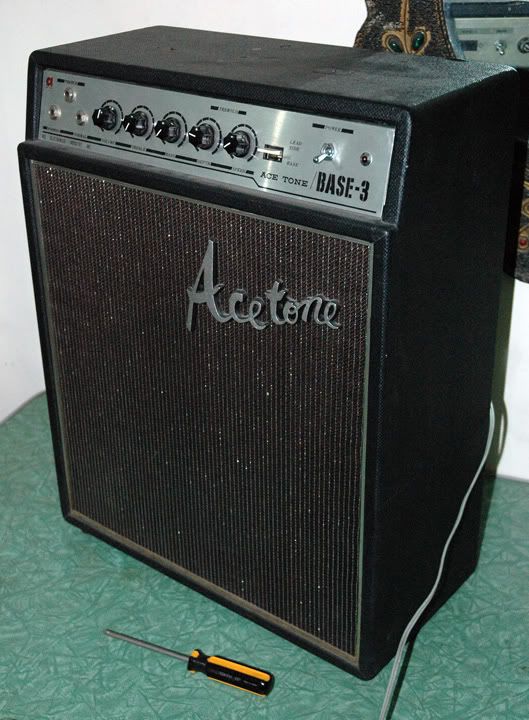
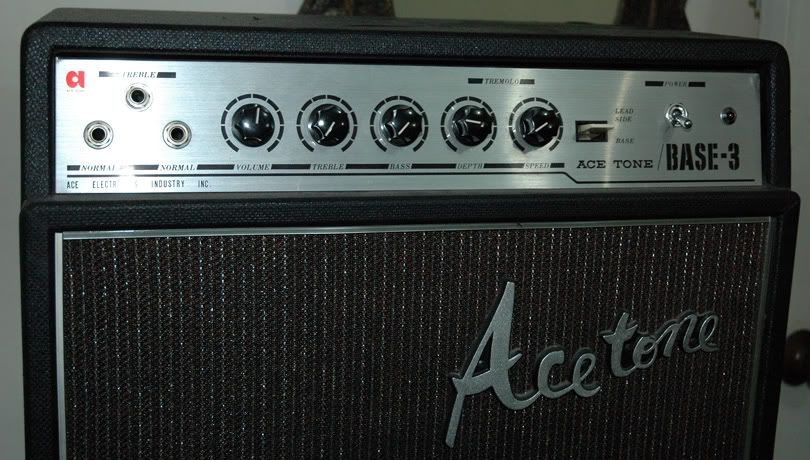
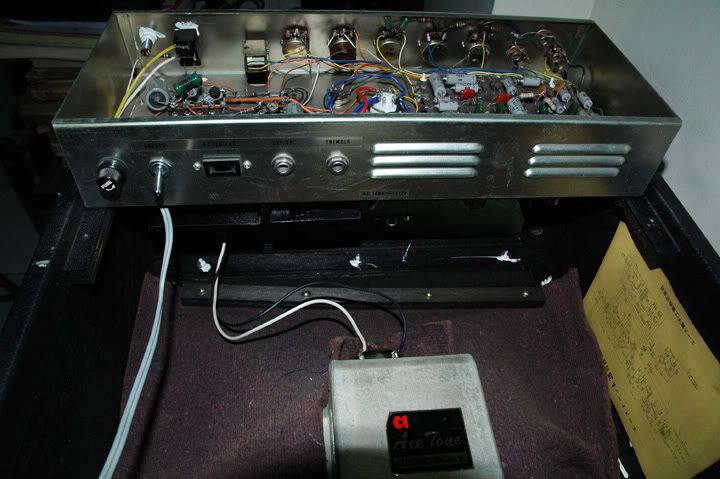
Ace Tone Base-3 Tube Amp / Ace Tone A-3B Tube Amp

Ace Tone Base-3 Tube Amp
aka Ace Tone A-3B Tube Amp
1960's?
Made in Japan, 100V

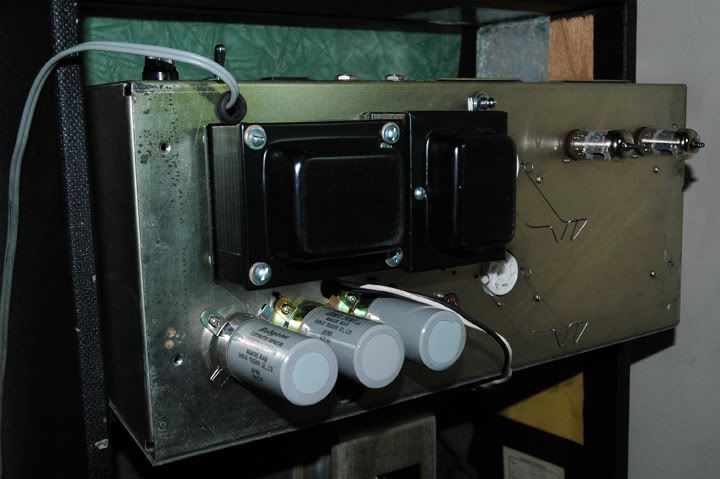
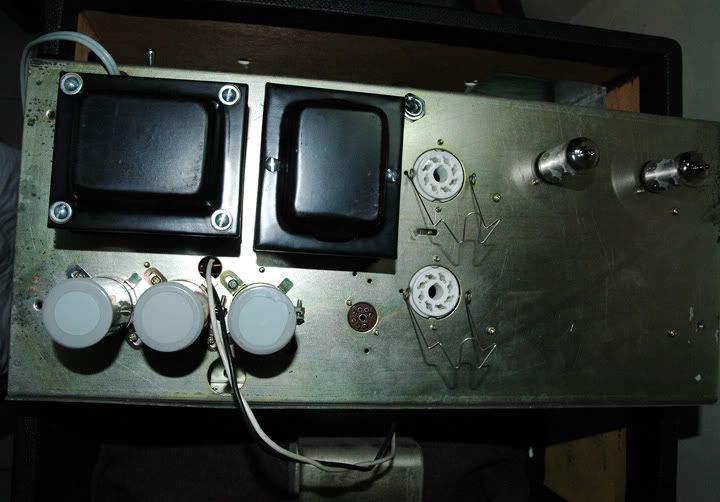
Tube Complement: 2 x 50H-B26 power tubes, 2 x 12ax7 preamp tubes, 1 x 6av6 tremolo tube

Speaker: 8-ohm, Alnico 12in., Ace Tone branded

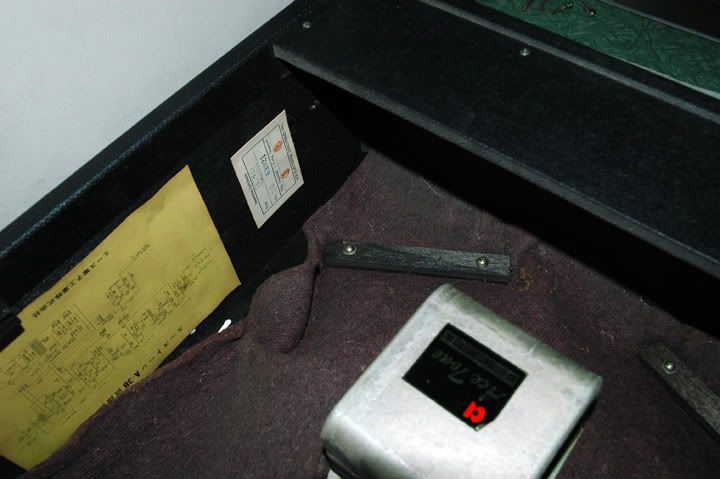
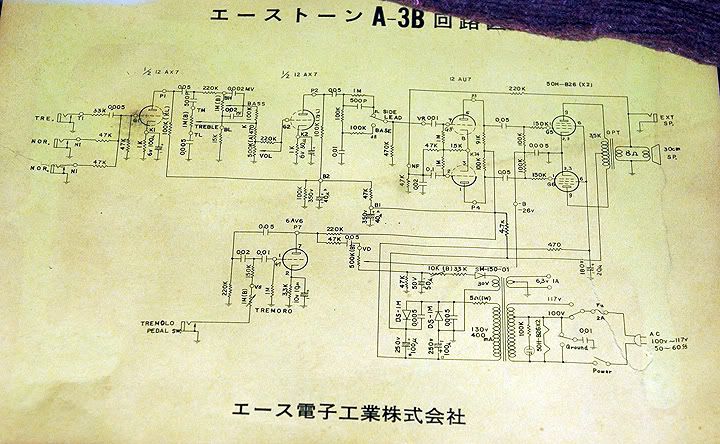
I've searched and searched and searched and could not find any information about this amp from the net. Fortunately, the amp came with a full schematic so all is not lost.

This is a highly intriguing amp. In original form, it uses an unheard-of power tube, namely, 50H-B26. Some info are available on the net for this tube so this is another plus.

This tube requires 50V AC for filament power and the filament of the 2 power tubes are connected in series at the primary side of the power transformer, getting filament power directly from the 100V Japanese house voltage.

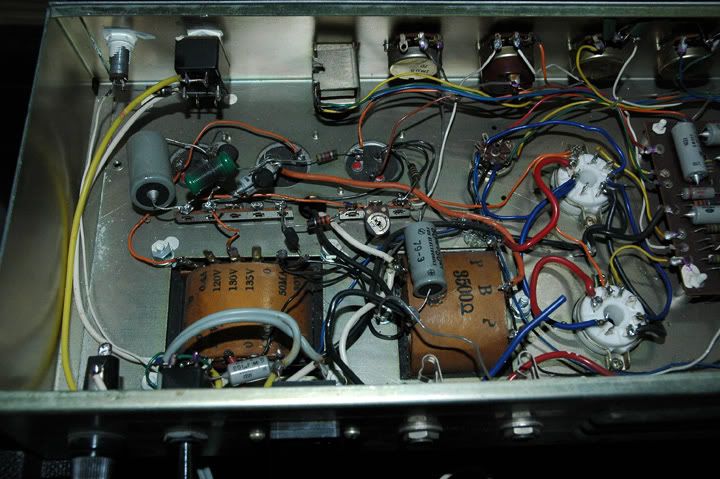
This explains why the 6.3 V output of the power transformer is designed for 1 Ampere only. It only need to provide filament power to two 12ax7s and one 6av6 tube. The power transformer therefore does not need to be so big.

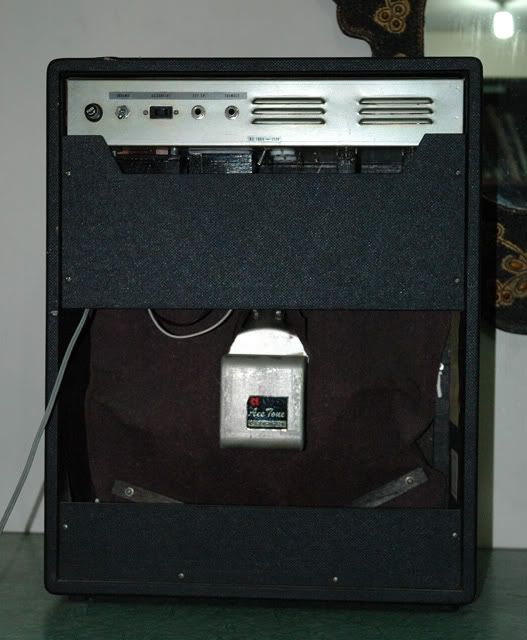
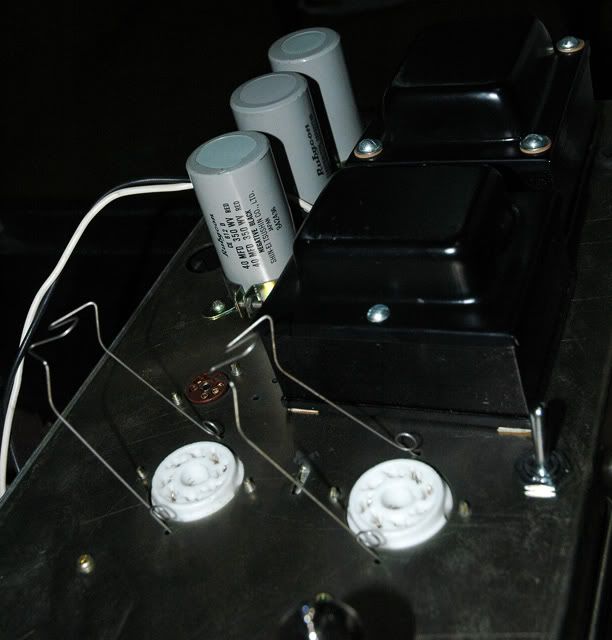
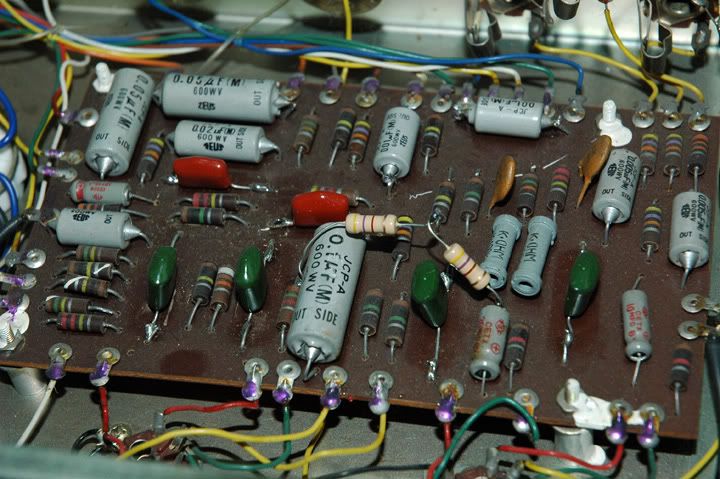
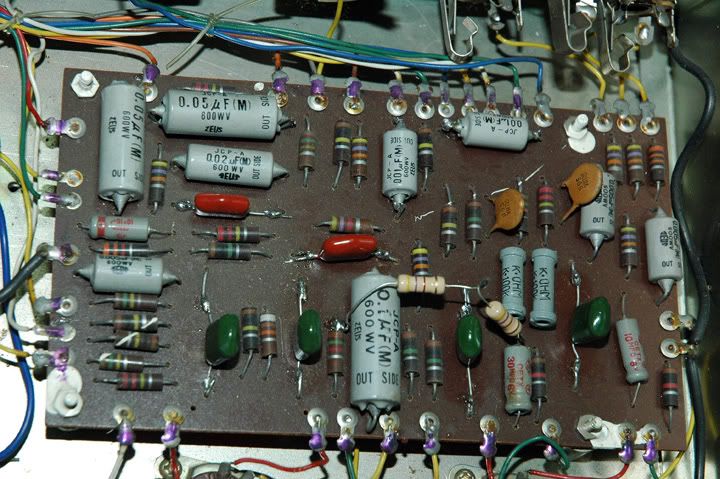
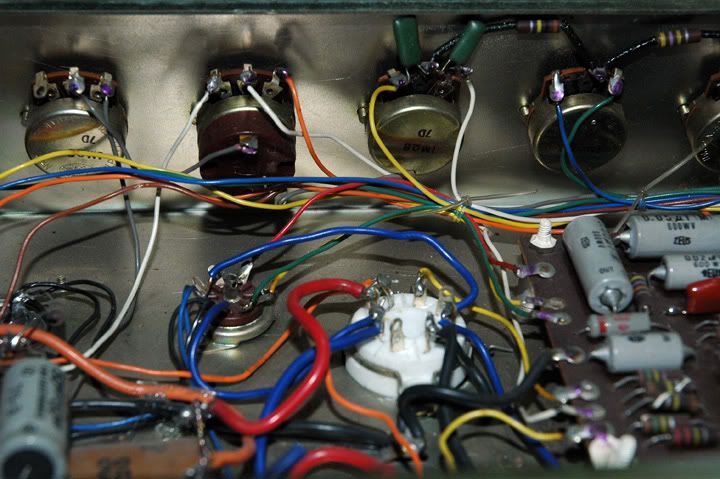
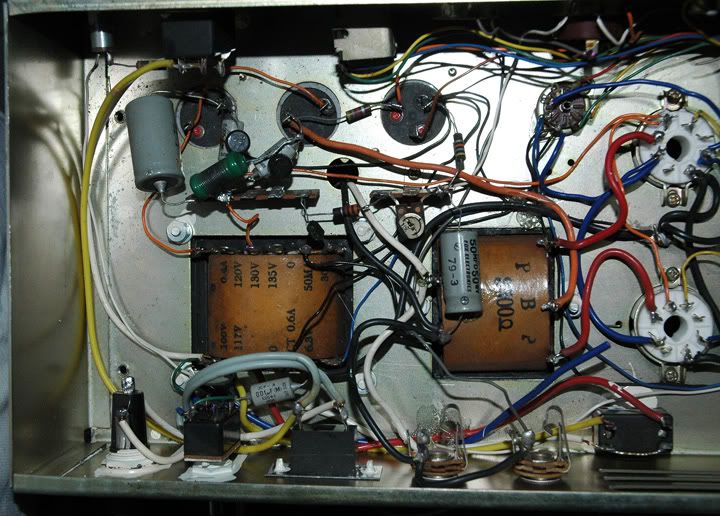
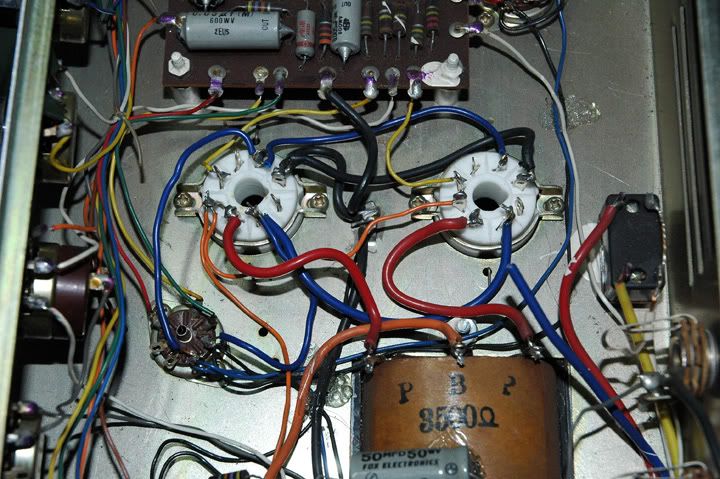
When I got it, the power tube bases were already converted to accept 6V6s. Whoever did the conversion did not scrimp on the tubes as they were DELCO brand 6V6s. The replacement tube bases used are ceramic type.

The work was done cleanly and looked like it was executed by somebody who knows what he was doing. Only upon consulting the schematic and looking closely on the actual amp components did I realize that the amp did not originally use 6V6s.

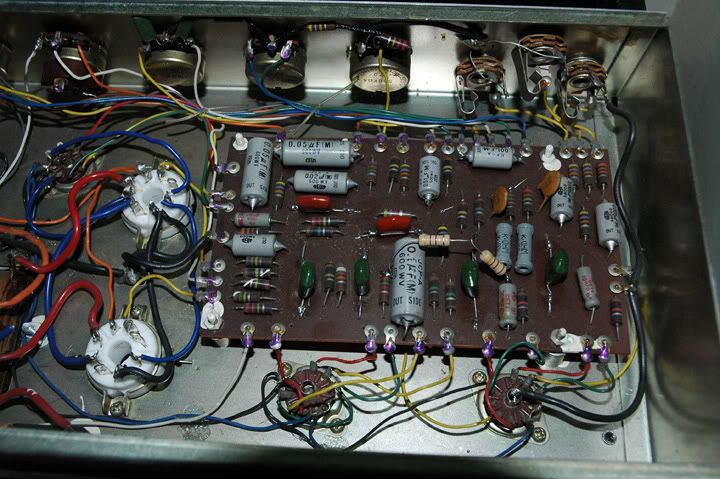
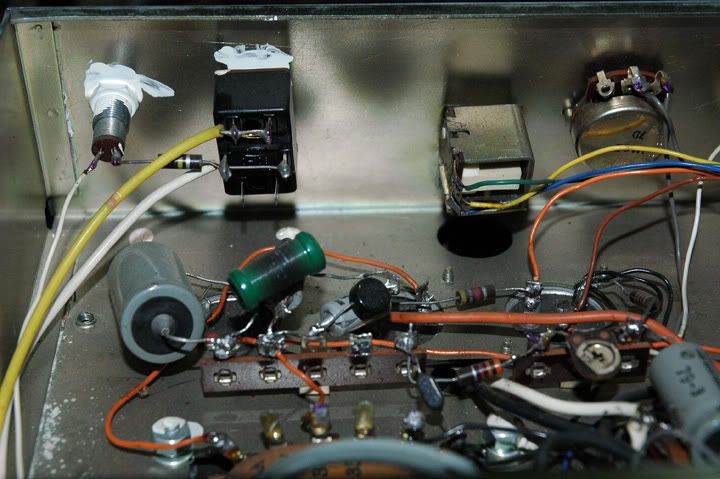
There is a minor modification done in the circuit board that does not look like it was done by the same person who did the tube conversion. It looked like temporary work to make a test. Fortunately this is easy to undo.

A number of the original paper-in-oil caps in the circuit board have been replaced.

The amp works and sounds good when I got it though there were no provisions made to supply the additional filament current required by the two 6V6s. It doesn't seem to have the power that could be expected from a push-pull 6V6 powered amp. This is most probably due to the lack of filament power to the preamp and power tubes.

I feel that the amp can give more output once a proper power transformer is installed or an additional filament transformer is added to supply the filament current required by the two 6V6s.

The 12-inch Alnico speaker has a big magnet and looks like it can handle 20 watts or more of output power. The speaker is blanketed at the back likely because the amp is designed for bass guitar as well as for guitar with a selector switch on the front panel.

The amp as it is, presents a very nice starting platform for conversion into any one of the classic amps as most of the ingredients are already there...